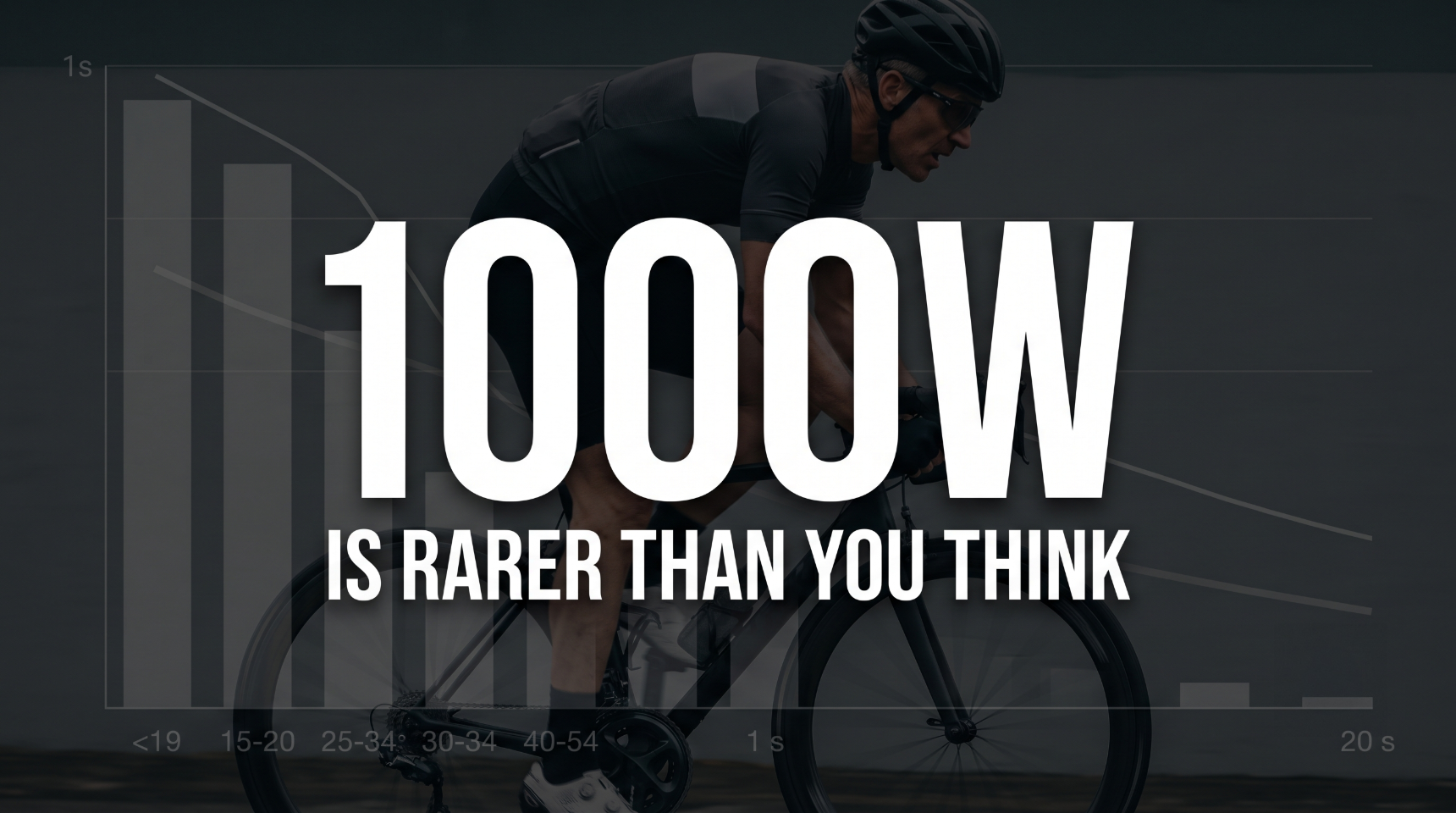
Everybody can hit 1000 watts!
A friend told Jeremy that everybody can hit 1,000 watts. Jeremy had never done it. His friend was shocked.
Jeremy wrote in to TrainerRoad’s Ask a Cycling Coach podcast and asked them to settle it with data. Coach Jonathan Lee pulled reliable sprint efforts from more than 100,000 athletes across a year of rides (indoor, outdoor, Zwift, all of it) and filtered the usual power-meter spikes that fake a hero number for one second.
The debate is over. Most people can’t.
What the numbers actually say
Hitting 1,000 watts for one second is already uncommon. Holding it is rare.
Among men in that dataset, about 28% have ever touched 1,000 watts for a single second. Stretch it to five seconds and you’re at 18%. Ten seconds: under 10%. Twenty seconds (the kind of effort that wins a real bunch kick): about 2.2%. Roughly one in forty-five men.
Women: about 5% at one second, 1.7% at five, and roughly one in five hundred at twenty seconds.
So if you’ve never seen four digits on your head unit, you’re not broken. You’re normal. The myth that “everybody can” mostly comes from people who either spiked a bad reading, weighed more than you, or were remembering a twenty-year-old version of themselves.
The part that matters for Masters riders
Jonathan also broke the one-second 1,000-watt mark by age. For men:
- Under 30: about 46%
- 30 to 39: about 35%
- 40 to 49: about 29%
- 50 to 59: about 21%
- Over 60: about 10%
That’s the chart I care about. Rollfast coaches men from 40 to 80. By the time you’re in our demographic, the share of riders who have ever kissed 1,000 watts once is already well under a third, and it keeps falling.
Some of that is body mass. Heavier riders can push more absolute watts, and the male sweet spot in their data landed around 180 to 200 pounds. Fine. Absolute watts win flat sprints. But Masters racing is rarely a pure flat bunch kick with a lead-out train. More often it’s a punch out of a corner, a short rise, a gap that opens for three seconds and then closes forever.
What you need there is usable neuromuscular power: five to fifteen seconds of real force, not a vanity peak you screenshot for the group chat.
Sprinting is a skill, not a fitness badge
Here’s where the TrainerRoad take and the Rollfast take meet.
You don’t get a better sprint by adding more Zone 2. You don’t get it by “just pushing harder.” Peak power is coordination under load: gear choice against speed, how you load the pedals when you stand, whether your nervous system can fire hard without folding into mush two seconds later.
Plenty of riders have the strength in the gym and still can’t put it on the bike. We’ve written about that before: gym force that never reaches the pedals is a transfer problem. Year-round strength builds the tissue. On-bike torque work and standing accelerations teach that tissue how to show up when the race gets ugly.
If you only ride endurance cadence and only lift in January, you should not be surprised when July asks for a sprint you never practiced.
How not to cook yourself chasing the number
All-out sprinting is expensive. Jonathan’s dosing notes match what we see with Masters athletes:
For 20- to 30-second max efforts, five quality reps in a session is plenty. Ten of those and you’ve borrowed from tomorrow and the day after. For short snaps (five to ten seconds) you can do closer to ten, because the glycolytic hole isn’t as deep, but the nervous system still pays.
One or two true sprint sessions a week is the ceiling for most riders who also race or do hard group rides. The day after should not be another high-intensity hammerfest. If you treat neuromuscular work like another interval day you can stack forever, your peak power goes sideways and your legs feel like wet rope.
And no, the goal is not “hit 1,000.” The goal is a sprint you can repeat when it matters. Clean acceleration. An honest peak. Enough left to cover the next move. For some of our athletes that number is four digits. For others it isn’t, and they still win their age group because they can put the power down at the right moment in the right gear.
What to do with this if you’re over 40
Stop treating 1,000 watts like a membership card.
Check your actual bests at 1, 5, and 12 to 15 seconds. Those tell you more about race usefulness than a single spiked second. If the 1-second number looks heroic and the 5-second number collapses, you don’t have a sprint. You have a twitch.
Then train what actually holds after 40. Keep strength year-round so you’re not renting force for eight winter weeks. Put torque and standing work on the bike so the gym shows up in the pedals. Practice short, honest accelerations when you’re fresh, not as an afterthought at the end of a tired endurance ride. And protect the day after (spacing the hard days wrong is how Masters riders lose the peak they just built).
The TrainerRoad data is useful because it kills a stupid comparison. Most riders never hit 1,000 watts. After 40, far fewer do. That does not write your season off. Peak power is rare. It is also a skill you can still build. Masters speed comes from precision, not from pretending you’re still 28 and arguing about a round number.
Build the sprint you can actually use
If you’re tired of guessing whether your peak power is “good enough,” stop comparing yourself to a round number and start building the system that puts force on the pedals when the race asks for it.
Rollfast coaching pairs year-round strength, on-bike torque and sprint skill, and recovery that respects a Masters nervous system. DOM grades the sprint sessions so you know if the power was real or just a twitch. Spots are limited; if you want the next block built around usable speed instead of vanity watts, start here.
Data referenced from TrainerRoad’s Ask a Cycling Coach podcast episode 591 (Coach Jonathan Lee), analysis of filtered sprint efforts across 100,000+ athletes. Watch the episode.
Matt Tanner is co-founder and head coach at Rollfast Coaching. We build Speed, Strength, and Longevity for Masters cyclists.

Related Posts
You’re Not Too Old for Intervals. You’re Just Spacing Them Wrong
Somewhere around your 50th birthday, the advice changes. Training partners, forum threads, even well-meaning coaches start telling you the same thing: ease off the hard stuff. You're not 25 anymore. Stick to Zone 2 and ride your age. It's the most comfortable bad advice in cycling, and the 2026 VO₂max research says it's wrong on the part that matters most. Masters athletes respond to high-intensity intervals as well as
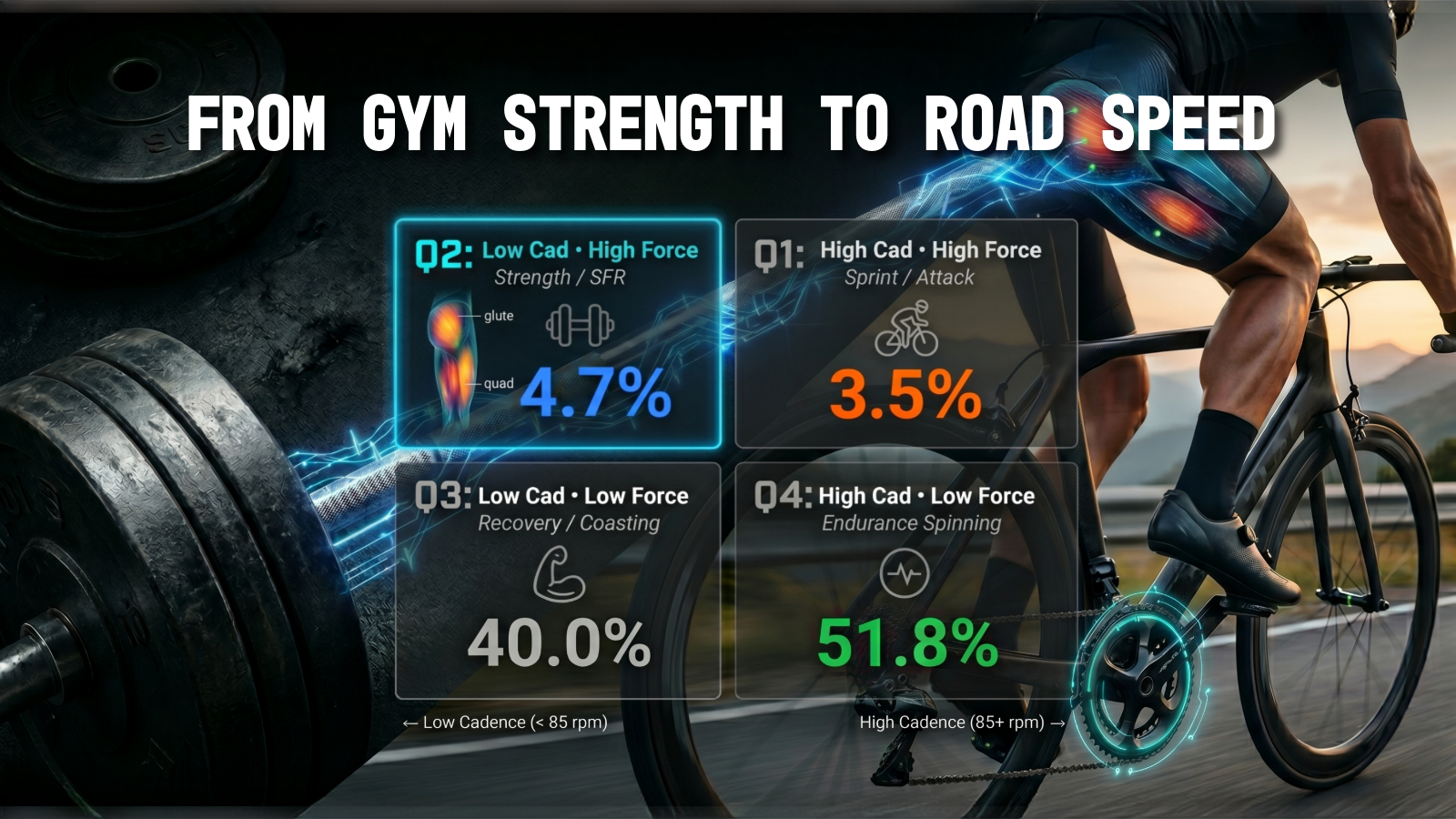
Why Your Gym Strength Never Reaches the Pedals (and How to Fix It)
You’re strong in the gym, hitting personal bests on your heavy lifts. So why do your legs lock up and your power fade when the road pitches up? The problem isn't your fitness—it's a fundamental failure in force transfer. Most cyclists are stuck training in one dimension, leaving their raw strength trapped in the weight room. This post introduces the critical 4 Power Quadrant Framework,
Getting Heavier Made Me Faster… and Healthier
Most endurance athletes believe a quiet lie. It’s rarely said out loud, but it shapes a lot of decisions. The belief that getting faster means getting smaller. That lifting weights is something you do carefully, or temporarily, or not at all if you care about performance. That strength, speed, and longevity pull against one another. For a while, that belief can even seem true. But over longer stretches