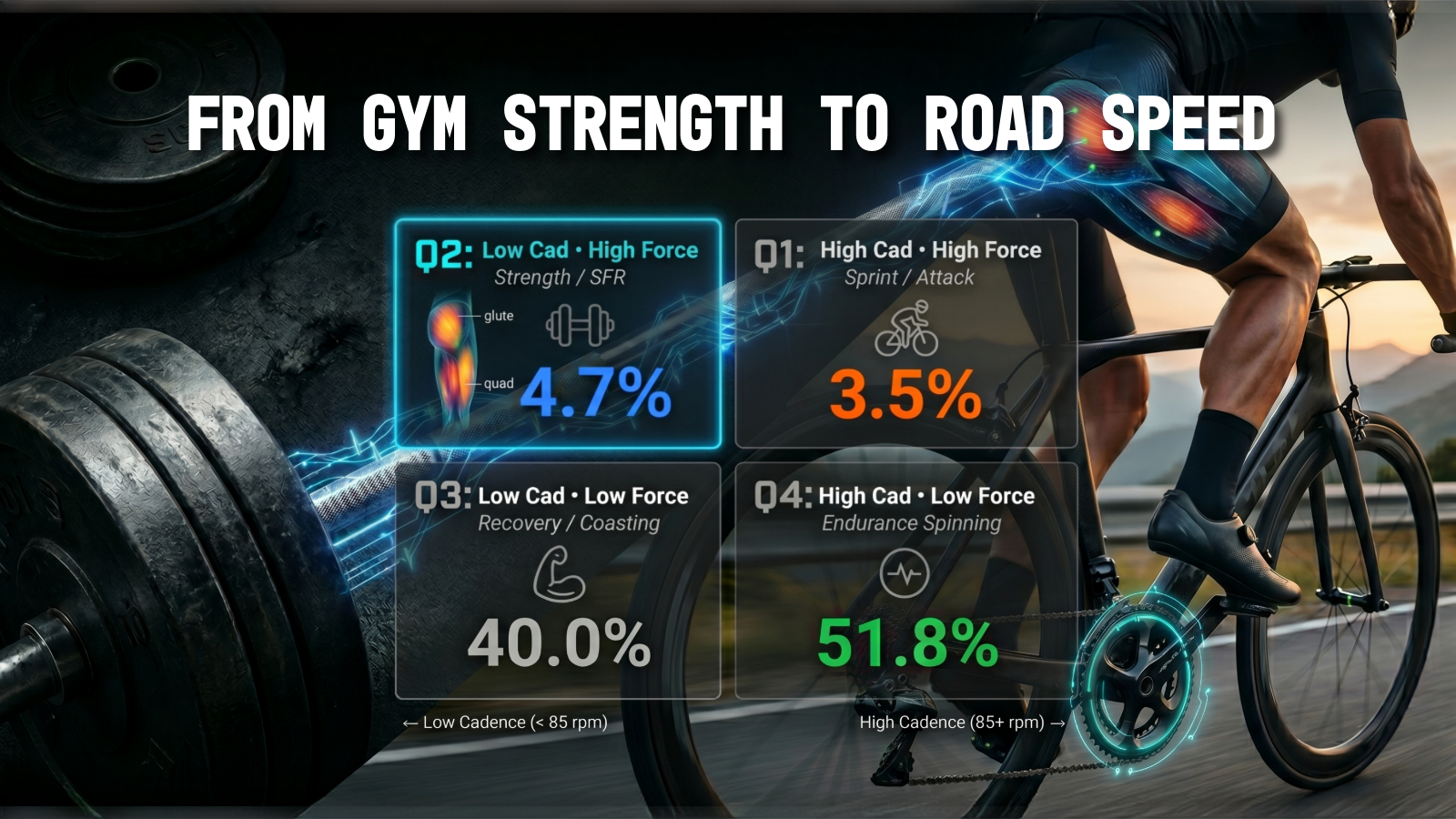
Why Your Gym Strength Never Reaches the Pedals (and How to Fix It)
The 4 Power Quadrants: Why Your Gym Strength Never Reaches the Pedals (and How to Fix It)
By Matt Tanner, Rollfast Coaching
You put in the hours in the weight room. You’re hitting personal bests on your heavy squats and deadlifts. You feel strong. Invincible, even.
But when the Sunday group ride surges out of a sharp corner, or the gradient pitches up to 12%, your legs lock up, your power fades, and you get dropped. You cramp on steep gradients even though you squat 1.5x your bodyweight. Your legs die in the final hour while lighter riders keep going. You can’t close gaps when the pace surges.
How can you be so strong off the bike, but feel so weak when it matters most?
The problem isn’t your fitness. It’s not your absolute strength. The problem is a fundamental failure in force transfer. Your gym strength exists—it just never reaches the pedals.
Most cyclists have never seen this. They train 90% of the time with the same cadence, same gear, and same recruitment pattern. And then wonder why they’re always a step behind.
This post isn’t just theory. It’s the same system I use with the athletes I coach, from club riders and busy parents to pro riders. This guide breaks down the critical Power Quadrant framework, shows you exactly where the problem lives, and gives you the proven protocol to fix it.
The Quadrant Framework: Unlocking Every Pedal Stroke
Power on the bike is a product of two things: cadence (how fast you turn the pedals) and force (how hard you push each stroke). Plot those on two axes, and your pedal strokes map out into four distinct zones, divided by your functional threshold.
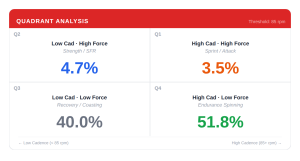
Rollfast DOM Ai shows your Quadrant Analysis in reports following your workout
- What it is: Peak power output. Think the final 200m sprint of a race—legs spinning fast, every stroke maximal. The most demanding quadrant. You can’t stay here long.
- When it shows up: Sprint finishes, final kicks, short all-out efforts at speed.
- The Trap: Many cyclists only develop this through high-cadence drills, missing the underlying force component that makes it truly explosive.
- What it is: This is where raw gym strength transfers to the bike. Low RPM, high torque. The pedal stroke here is the closest thing to a weighted step-up or squat you’ll find on two wheels.
- When it shows up: Accelerations out of sharp corners, punching over short steep climbs, gravel or cobble sectors, closing gaps under load, any moment you go from slow to fast with resistance.
- Why it matters most: This is the bridge between gym and bike. Without Q2 work, your squat stays in the gym. This is the missing link for 90% of frustrated cyclists.
- What it is: Recovery. Coasting. Sitting in the pack. Low output, low demand.
- When it shows up: Sitting in the peloton, descending, soft pedaling between efforts.
- The Goal: Recover efficiently here so you can hit Q1 and Q2 when it matters.
- What it is: Spinning easy. Light gear, fast legs, low muscular load. The cardiovascular system does the work, not muscle force. Most cyclists spend 90% of their time here.
- When it shows up: Endurance riding, tailwind sections, spinning out on descents, warming up.
- The Problem: If this is your only training quadrant, you become a one-dimensional rider, unprepared for surges, climbs, and tactical demands.
The Neuromuscular Disconnect: Why Your Strength Is Trapped
Here is exactly why your gym strength isn’t translating:
- Lifting heavy weights is a Q2 activity (massive force, very low velocity).
- Riding your bike on a standard endurance day is a Q4 activity (low force, high velocity).
If you only lift heavy in the gym and only spin lightly on the bike, your neuromuscular system never learns how to bridge the gap. Your brain doesn’t know how to recruit those newly built, high-force motor units while pedaling. You have the engine—you just haven’t connected it to the wheels.
This disconnect is why you experience:
- Cramping on steep climbs: Steep gradients force Q2 (low cadence at high power). If you never train it, your muscles aren’t conditioned.
- Getting dropped out of corners: Accelerating from near-zero speed in a big gear is pure Q2. If your training lives only in Q4, you lack the neuromuscular prep.
- Legs dying in the final hour: Fatigue recruits fast-twitch fibers built in the gym. Without Q2 work, they can’t contribute efficiently on the bike.
- Fading on short, punchy climbs: These demand rapid Q2 and Q1. Q4-only training destroys you here.
- Inability to hold the wheel when pace surges: It’s a quick jump to Q2/Q1 demand that your body hasn’t practiced.
The Rollfast Fix: Multidimensional Programming
At Rollfast Coaching, we don’t just assign “sweet spot” and tell you to ride. We engineer your training to build a neuromuscular bridge from the squat rack to the road. Our multidimensional programming actively integrates Quadrant 2 into your on-bike intervals.
We utilize a specific Gym-to-Bike Transfer Sequence heavily featuring SFRs. Created by Italian sports scientist Aldo Sassi in 1983, SFR stands for Salite Forza Resistenza (climbing strength resistance). It is a traditional cycling workout specifically designed to increase climbing power, leg strength, and pedaling efficiency.
By putting you in a massive gear on a climb and forcing you to produce power at 40-60 RPM, we force your body to generate gym-level torque through the pedal stroke. This specific Q2 stimulus forces the central nervous system to recruit the fast-twitch muscle fibers you built in the weight room and train them to fire in a cycling-specific motion.
But we don’t stop there. Once that neuromuscular bridge is built, we immediately follow it with high-cadence speed work, training those heavy-hitting muscle fibers to contract faster. That is how strength actually becomes speed.
Real-Time Validation with Rollfast DOM Ai: No Guesswork, Just Proof
Prescribing multidimensional workouts is only half the equation. The other half is ensuring you actually execute them correctly. When an interval gets painful, it is incredibly easy for an athlete to unconsciously default back to their comfort zone—spinning in Q4 instead of grinding in Q2.
At Rollfast Coaching, we aren’t messing around with guesswork. To guarantee your gym strength is transferring to the road, we have deployed our proprietary DOM Ai system to run daily analyses on your quadrant work.
Every time you finish a ride, DOM Ai dissects the math behind your pedal strokes. It analyzes your historical 90-day quadrant trends to map your exact physiological baseline, and then cross-references those trends against the specific quad focus of your daily workout.
- Did you actually hit the high-torque Q2 numbers we prescribed?
- Did your neuromuscular system effectively transition into Q1 during the sprint?
- Or did you slip into Q3 recovery when things got hard?
DOM Ai instantly identifies your physiological weak spots and confirms when the prescription is followed to the letter. We empower our athletes with absolute clarity and real-time knowledge. You will know exactly where your power profile is lacking and exactly how your daily execution is fixing it, ensuring you never waste a single pedal stroke.
Stop Being a One-Dimensional Rider. Start Dominating.
If you are tired of getting dropped on punchy climbs, struggling to close gaps, or feeling your gym strength go to waste on the bike, your training needs to be multidimensional.
This isn’t about training harder; it’s about training smarter. It’s about connecting your raw power to your pedal stroke and building a robust, versatile engine that can respond to any demand the road throws at you.
Ready to stop getting dropped and start dominating? Unlock your full potential with Rollfast Coaching. We’ll build your multidimensional power profile and connect your strength to your speed. Let’s get to work.
Matt Tanner is the founder and head coach at Rollfast Coaching, based in Carmel, IN and Clearwater, FL. Learn more about how Rollfast Coaching builds Speed, Strength, and Longevity at coaching.rollfast.us

Related Posts
Blood Flow Restriction Training: Breakthrough or Bullsh*t for Masters Cyclists?
Blood Flow Restriction (BFR) training: breakthrough or bullsh*t for Masters cyclists? In this deep-dive interview, Physical Therapist Joel Novak cuts through the hype, explaining how BFR's unique physiological stress can enhance muscle growth, endurance, and recovery with less joint load. Discover safe protocols, debunk common myths, and learn how BFR integrates with Rollfast's philosophy to optimize speed, strength, and longevity, whether you're rehabbing an injury
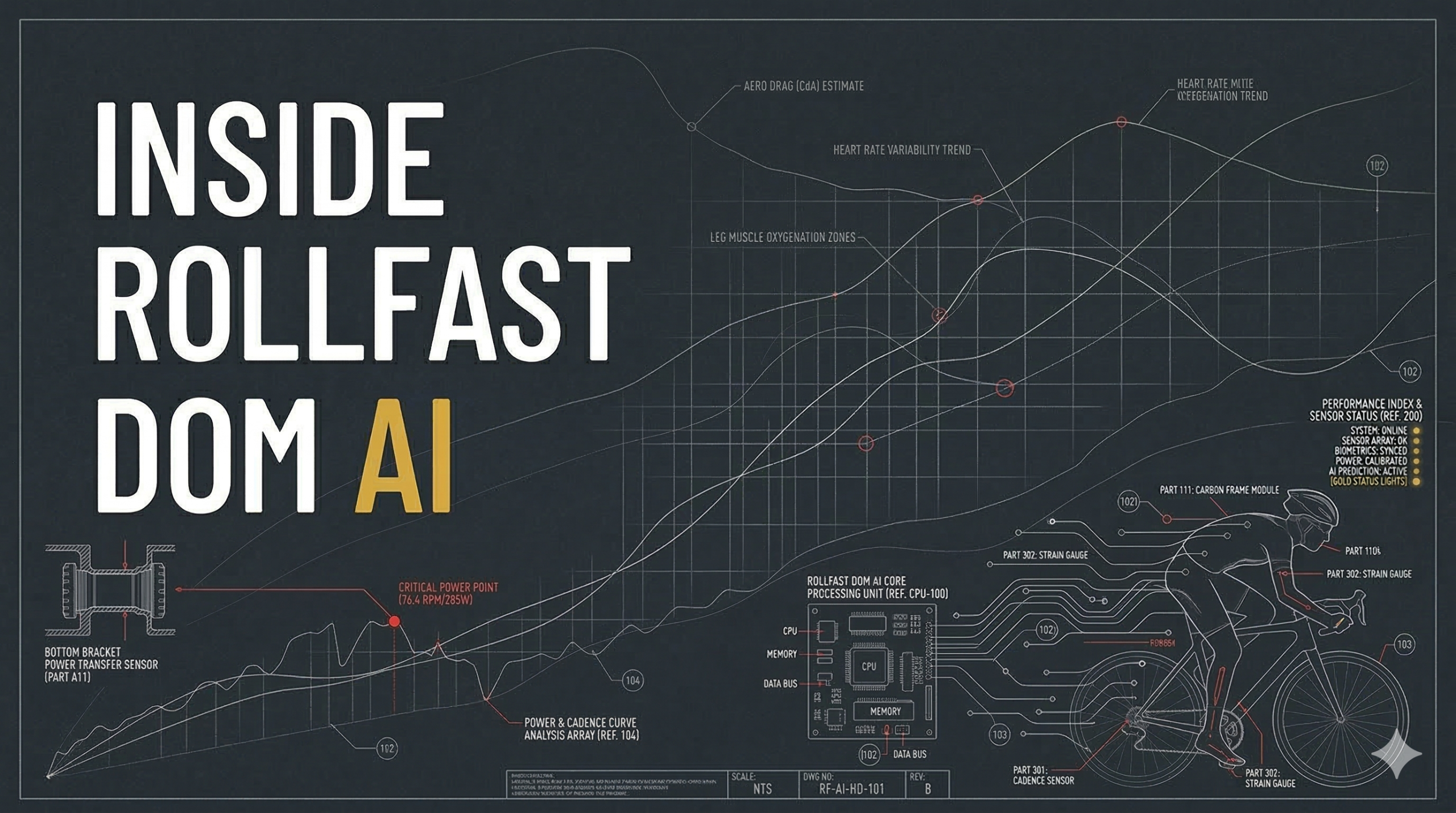
Why Your Data Deserves Better: Inside Rollfast DOM AI
Most cyclists are swimming in data. Garmin, Wahoo, Zwift, Strava, TrainingPeaks… the numbers are endless. But here’s the blunt truth: raw data, without context or expert interpretation, is just noise. It can lead to confusion, frustration, and even actively detrimental training decisions. At Rollfast Coaching, we believe your commitment to performance and longevity deserves more than generic analytics or the latest pro-level fads. It deserves a

Getting Heavier Made Me Faster… and Healthier
Most endurance athletes believe a quiet lie. It’s rarely said out loud, but it shapes a lot of decisions. The belief that getting faster means getting smaller. That lifting weights is something you do carefully, or temporarily, or not at all if you care about performance. That strength, speed, and longevity pull against one another. For a while, that belief can even seem true. But over longer stretches