How to Ride Closer to the Wheel Without Panicking
Speed · Group rides
You’ve probably been there. The group is rolling at a solid pace, you’re sitting a comfortable three feet off the wheel in front of you, and you feel okay. Then the pace ticks up. Someone attacks or the road tilts, and you’re suddenly at your limit while the person right on that wheel looks like they’re barely trying.
It’s not always fitness. A lot of riders who get dropped on group rides have plenty of engine. What they don’t have is the confidence to close the gap. They leave three feet of open air, lose most of the draft, and do somewhere between 20 and 30 percent more work than the riders sitting in correctly. By the time the hard part of the ride arrives, they’re already running on fumes.
The draft is the cheapest speed in cycling. Learning to actually use it is worth more than months of base miles.
Why the gap costs you so much
When you’re riding at 22–25 mph, aerodynamic drag is your biggest enemy. Sitting directly in the slipstream of the rider ahead, about one wheel-length back, cuts that drag dramatically. Studies on pack riding consistently show drag reductions of 25–40 percent for riders sitting in the draft compared to riding solo. The further back you drift from that wheel, the more of those benefits you give up.
Three feet sounds like nothing. On a bike at speed, it’s enough to put you back in clean air and out of the draft almost entirely.
The math plays out the same way every time: the rider doing extra work, mile after mile, arrives at the final climb or the group’s finishing sprint with less in the tank. Not because they’re less fit, but because they burned more fuel getting there.
The real reason riders leave the gap
It’s not laziness or lack of awareness. It’s nerves, and that’s completely understandable.
Riding a few inches off another person’s rear wheel at 23 mph feels genuinely dangerous when you’re not used to it. You’re staring at their wheel, bracing for contact, ready to grab the brakes at the first twitch. That tension makes you drift back. Every time the gap opens, you brake a little late, then accelerate hard to close it, then brake again. That accordion effect costs energy and makes the ride feel jerkier than it needs to be.
The fix isn’t courage. It’s technique, and technique can be practiced.
A three-ride progression
You don’t close from three feet to six inches in one session. Here’s how to build the skill deliberately, starting from wherever you are right now.
Ride one: start at two feet, hold it there
Pick a consistent point to focus on: the small of the rider’s back, or the center of their jersey number if they’re wearing one. Do not stare at their rear wheel. Looking at the wheel locks your vision six feet ahead of you and makes every movement look violent and sudden. Looking higher gives you more time to read what’s coming.
At two feet off the wheel, you’ll start to feel the draft. Your perceived effort will drop slightly. Notice that. It’s proof the system works.
Ride two: work down to one wheel-length
One wheel-length is roughly 26–27 inches. That’s the target. At this distance, you’re getting most of the aerodynamic benefit and still have a small buffer.
This is also the ride to practice soft-pedaling instead of braking. When the gap starts to close faster than you want, ease pressure off the pedals first. Brakes are a last resort. They cause the rider behind you to react, which cascades backward through the group. Soft-pedaling is smooth; braking is a surprise.
Soft-pedaling is smooth. Braking is a surprise.
Ride three: hold position through varied terrain
The gap management that’s easy on flat pavement gets harder on rollers and through corners. Practice staying consistent: hold your line through bends rather than drifting wide, keep your hands relaxed on the bars (tight hands transmit road feedback up your arms and make you twitchy), and keep elbows slightly bent as shock absorbers.
This is also the ride to practice taking a bottle from your cage without moving sideways in the group. Pick a smooth section, reach down deliberately, take a sip, return the bottle, and do not drift. Most riders move two to three feet laterally the first few times they try this at speed. It’s fixable.
Before the group ride
The 10-minute drill on a quiet road
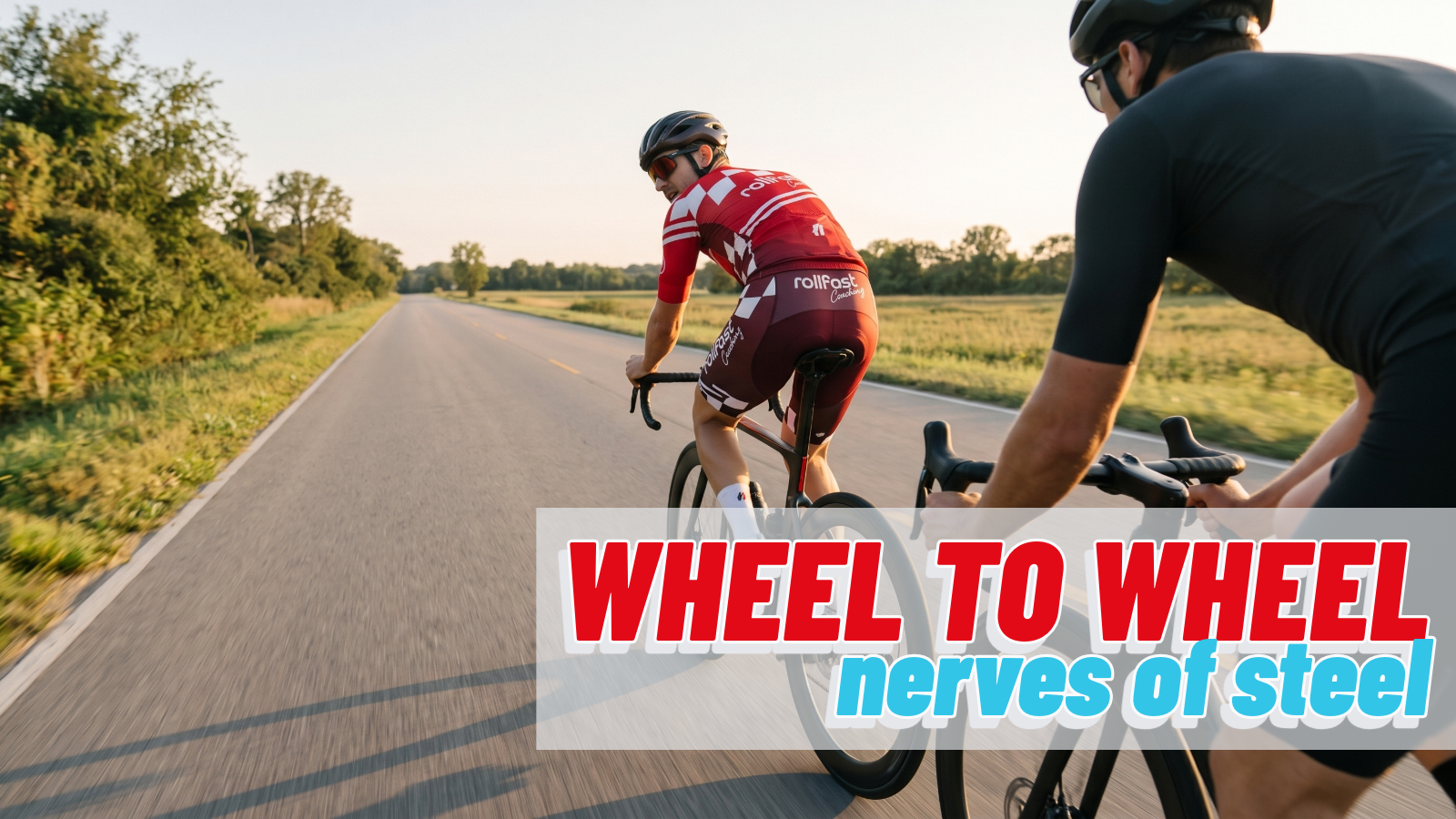
Before you try this in a full group, do it with one trusted riding partner on a road with low traffic and no stop signs. One rider leads at a steady 18–20 mph. The other sits in, starting at two feet off the wheel. Every two minutes, the following rider closes six inches. By minute ten, they should be within eight to ten inches of the rear wheel.
- Talk through it afterward. Did the following rider over-brake? Drift? Accelerate unevenly?
- Do the drill twice, then swap roles. Leading with someone on your wheel is its own skill.
- Film it (bonus points). Use a GoPro on your helmet or handlebars, or Oakley Meta glasses if you have them.
This controlled environment removes the social pressure of a group and lets you focus entirely on the mechanics. And once you’ve led, you’ll become a smoother rider in front because you know how your movements affect the person behind you.
The camera will show you things you can’t feel in the moment. Gap creep is almost always bigger on video than it felt while you were riding. Watching the footage afterward, you’ll spot exactly when you over-braked, when your line drifted, and whether your gap held steady or yo-yoed.
Riders who review even five minutes of footage from a drill session improve faster than those who rely on feel alone.
The position offset
One underused trick: sit very slightly to the left or right of the rider ahead rather than directly behind them. Not wide, just a few inches. This does two things.
Benefit one
You see more road
It gives you a better view of the road ahead so you can read what’s coming and react earlier.
Benefit two
Contact is recoverable
If there’s contact between wheels, it’s more likely to be a glancing touch than a straight-on overlap. A glancing touch between tires is usually recoverable. A front wheel hitting the back of another directly is harder to manage.
The offset also makes you a more considerate wheel to have on your tail. The rider in front can see you in their peripheral vision, which tends to make everyone calmer.
Etiquette before you jump on
Say it plainlyIn a group you don’t know, ask before sitting on someone’s wheel.
Drafting etiquette varies by region and by the culture of the group. Some casual rides are totally open to it. Others have unspoken norms about whether unknown riders are welcome to grab a free ride without taking a turn at the front. When in doubt, introduce yourself, ask if they mind if you roll with them, and offer to take a pull.
In your regular club ride, this is already figured out. On a random Saturday morning group, or chasing down a rider you don’t know, a quick word goes a long way.
The energy you save is energy you keep
There’s a reason experienced racers and seasoned gran fondo riders seem to float through the first three hours of a hard ride and then still have something left when it matters. Part of it is fitness. A big part is positioning.
Every kilojoule you save sitting in the draft is a kilojoule you still have when the road goes up or the pace goes sideways. That’s the Rollfast take on this skill:
Smooth beats strong. Smart positioning is the cheapest watts you’ll ever find.
Closing the gap isn’t recklessness. Done right, it’s the most efficient thing you can do on a bike.
Sources
r/velo. Group Riding Wiki
r/CyclingMSP. Drafting Etiquette
RoadBikeRider. Why Am I Slower on Group Rides Even Though I’m Fit?
Speed · Strength · Longevity
Skills are coachable, too
If you want to work on skills like this alongside your structured training, Rollfast coaches build both. Sitting in the right spot in the group is the cheapest speed you’ll ever find, and it’s coachable.

Related Posts

Elevation, Execution, and Emptying the Tank: Inside the 2026 Rollfast Tucson Camp
Elevation, execution, and emptying the tank. Go inside the 2026 Rollfast Tucson Camp to see how our athletes tackled Mt. Lemmon, mastered Momentum Capture, and built unshakeable Mental Fitness. Read the week's recap and mark your calendars for February 2027.
Why I almost gave up on cycling.
When your identity is tied to your performance and the numbers start to fail, the descent is soul-crushing. After months of fighting infection, "wrecked" performance, and a body that wouldn't cooperate, I hit the breaking point. This is a raw look at my recent struggle, why I almost gave up on the sport, and the specific circle of support that helped me rebuild the engine

Forget Base Miles and Build a Launch Pad
The Zone 2 Myth Every winter, cyclists talk about “base miles.” Endless hours in Zone 2. Long slow rides. “Building the engine,” they say. Yet when spring comes, their power curve looks the same as last year—or worse, their legs feel dull when intensity returns. The problem isn’t effort; it’s misunderstanding what base training actually is. Somewhere along the way, base training got reduced to “ride a lot