You’re Not Too Old for Intervals. You’re Just Spacing Them Wrong
Somewhere around your 50th birthday, the advice changes. Training partners, forum threads, even well-meaning coaches start telling you the same thing: ease off the hard stuff. You’re not 25 anymore. Stick to Zone 2 and ride your age.
It’s the most comfortable bad advice in cycling, and the 2026 VO₂max research says it’s wrong on the part that matters most.
Masters athletes respond to high-intensity intervals as well as younger athletes do. The adaptation (the bump in VO₂max, the top-end that keeps you in the front group) is still fully available to you. What changes with age isn’t whether you respond. It’s how much it costs you to recover, and therefore how you have to space the work.
Get that one distinction right and you stop throwing away the single most age-defiant stimulus you have left.
The intensity isn’t the problem. The calendar is.
Here’s what actually happens to the rider who buys the “go easier” story. He swaps his intervals for endless steady miles, feels virtuous about all that base, and six months later wonders why his VO₂max, the number most tightly linked to both performance and longevity, has quietly slid. He didn’t get old. He stopped giving his body the one signal that defends the top end, and Zone 2 alone won’t hold it.
The meta-analysis work on training intensity is blunt about this: it’s the hard efforts that move VO₂max. You can’t gentle your way to a bigger engine. And the research on Masters specifically shows the engine still grows when you ask it to. Your physiology didn’t get the memo that you’re “too old.”
What did change is the recovery cost. A 28-year-old can stack three hard sessions in a week and absorb them. Ask a 55-year-old to do the same and the fourth one isn’t training; it’s just digging a hole. The adaptation is identical. The runway you need between the big efforts is not.
Don’t water it down. Dose it like a Masters athlete
This is exactly why Rollfast anchors zones to a proper dual-effort VO₂ test instead of a blunt 20-minute FTP estimate. If you’re going to spend your hardest, most expensive sessions of the week, the targets had better be real, anchored to the system you’re actually trying to develop, not a number that drifts every time you’re tired or motivated.
Then you protect those efforts and engineer everything else around them:
Keep the intensity honest. When it’s a VO₂ day, it’s a VO₂ day: full-quality intervals at the right anchor, not gray-zone fudging. Watering down the hard work to make it “age-appropriate” is how you get the fatigue of training hard with the adaptation of training easy.
Buy the recovery you actually need. More easy days between the hard ones. Not because intensity is dangerous, but because the absorption window is longer now, and the magic happens in the absorbing, not the doing. Where a younger rider might go hard every second or third day, you might go every third or fourth. Same sessions, more space.
Back it with the inputs that govern recovery. This is where Speed meets Longevity. Sleep, protein, and a hormonal environment that isn’t running on empty decide how fast you clear a hard session. The Masters rider who sleeps seven-plus hours and eats enough protein recovers from intervals on a younger man’s timeline. The one running ragged needs even more spacing, or pays for it.
The takeaway
“You’re too old for intervals” quietly became the default story for aging cyclists, and it’s costing them the exact fitness they’re most afraid of losing. The hard efforts still work. Your body still responds. You just can’t run them on a 25-year-old’s frequency.
So don’t retire the intensity. Re-space it. Anchor the efforts properly, give yourself the extra day or two to absorb them, and protect the sleep and fuel that make recovery fast, and you keep the top end that “ride your age” would have slowly bled away.
You’re not too old for intervals. You’re just running them on the wrong calendar.
Sources:
- “VO2 Max Workouts for Cyclists Over 40: 3 Sessions That Work” (Roadman Cycling): https://roadmancycling.com/
blog/vo2-max-workouts- cyclists-over-40 - “The Effect of Exercise Training Intensity on VO2max in Healthy Adults: An Overview of Systematic Reviews and Meta-Analyses” (PMC): https://pmc.ncbi.nlm.nih.gov/
articles/PMC11022784/

Related Posts
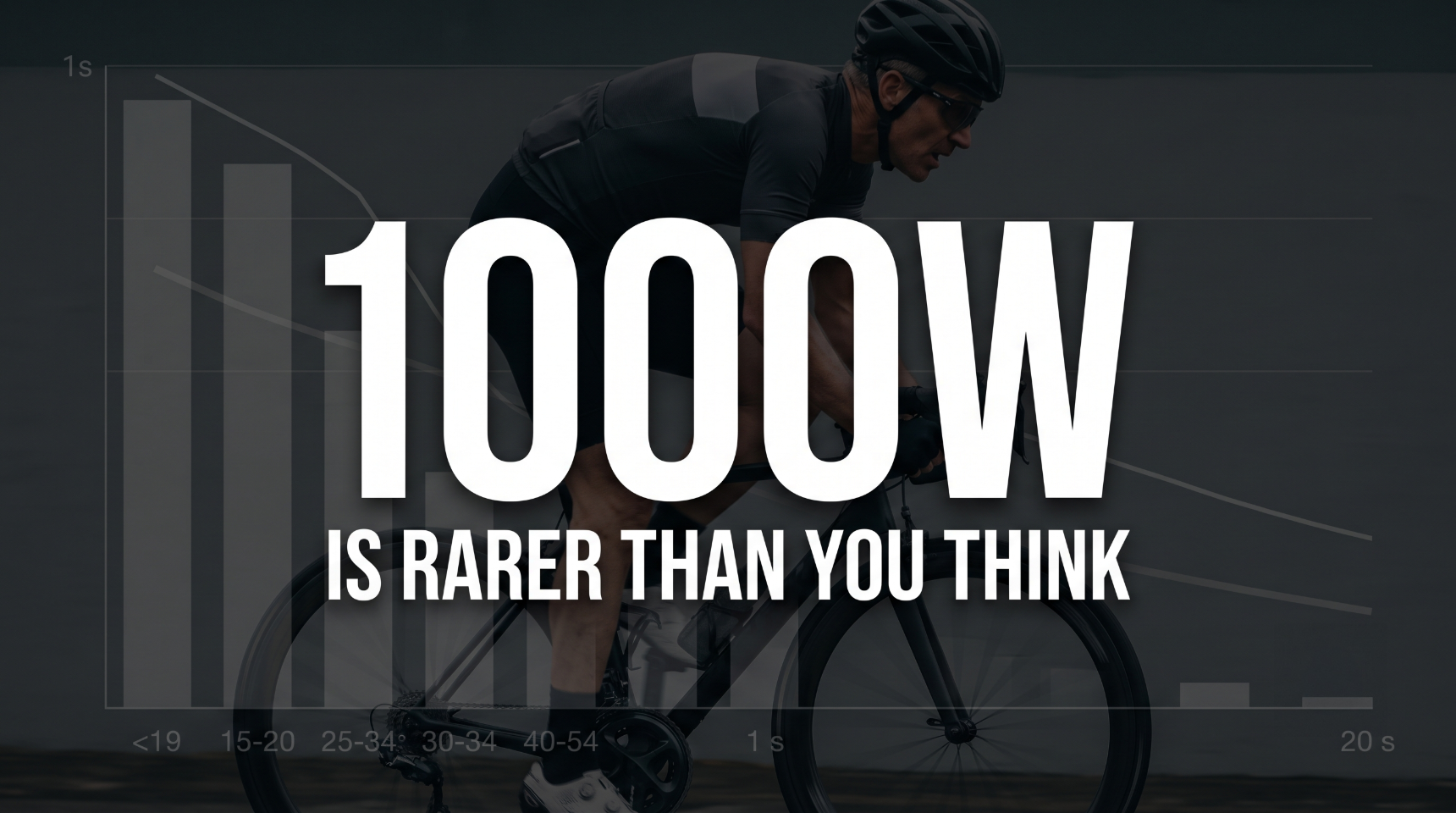
Everybody can hit 1000 watts!
Most men never hold 1,000 watts for a real sprint — and after 40, far fewer do. TrainerRoad's data kills the myth. Here's what Masters riders should train instead of chasing a vanity number.