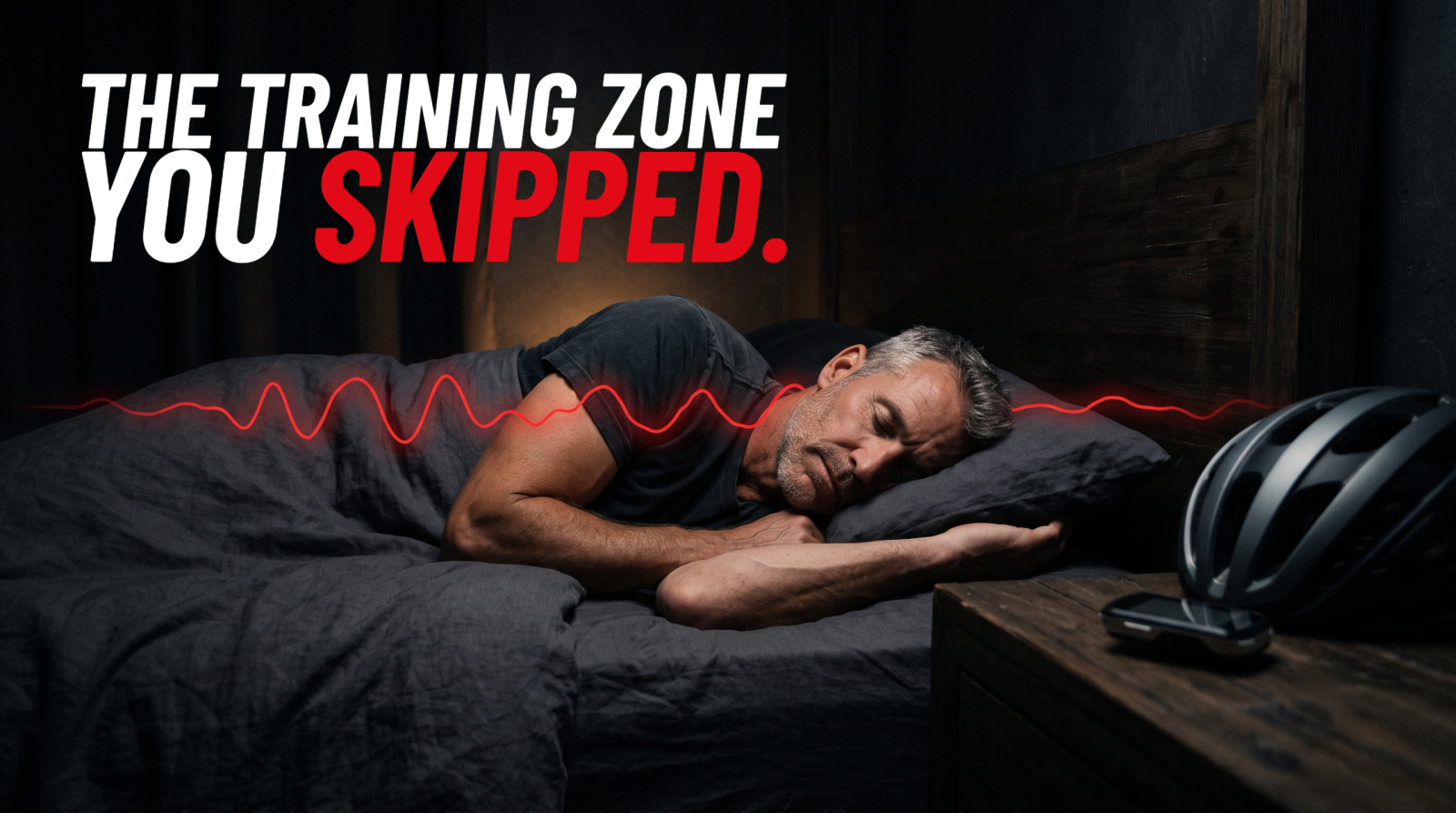
Deep Sleep Is a Training Zone, and You’re Getting Locked Out of It
You track your power. You log your intervals. You probably have a training stress score from last week memorized. But there is one training zone you are almost certainly not measuring, not protecting, and not even thinking of as a zone at all: deep sleep. And after 50, the body starts locking you out of it.
This is not a story about feeling rested. It is a story about whether the work you did on Tuesday actually sticks.
What Happens in Deep Sleep That Cannot Happen Anywhere Else
Sleep has stages. Most people are vaguely aware of REM, the dreaming phase, but for a Masters athlete the more important territory is slow-wave sleep, also called deep sleep or N3. This is the phase where your pituitary gland releases the bulk of your daily growth hormone.
Not a trickle. The bulk. Roughly 70 percent of daily growth hormone secretion in healthy adults occurs during the first slow-wave cycle of the night, typically in the first one to two hours after sleep onset. This is not optional chemistry that you can compensate for with nutrition or cold water. It is a gated process: the slow wave opens the gate, and if you do not get adequate slow-wave sleep, the hormone does not get released at the same level.
Growth hormone is central to everything you care about as a rider working to stay fast and structurally intact past 50. It drives protein synthesis in muscle tissue, supports connective tissue repair, mediates the turnover of the type 2 muscle fibers that generate power and that you are working hard to preserve and rebuild. Without adequate growth hormone signaling overnight, the damage from a hard training session does not get fully repaired. The supercompensation you are chasing, the small upward ratchet that makes you a little more capable than you were before the effort, gets blunted or delayed.
Here is the blunt version:
If you are sleeping poorly, the interval session you did on the bike or the heavy squat set in the gym is not building you. It is accumulating as debt.
The Age Slide Nobody Tells You About
Here is where it gets specifically problematic for Masters riders. Deep sleep does not stay constant across a lifespan. It shrinks.
Research on sleep architecture shows a well-documented pattern: slow-wave sleep decreases progressively with age, with meaningful declines beginning in middle adulthood and accelerating through the 50s and beyond. The decrease is not just in total duration. The depth and continuity of slow-wave sleep also degrades. You cycle into lighter stages more frequently. Arousal threshold drops. A noise, a bathroom trip, even a slight shift in core temperature can pull you out of a slow-wave episode that your 30-year-old self would have slept straight through.
For the 30-year-old racer, a hard Tuesday threshold block followed by a good night of sleep means deep sleep cycles run long and clean, growth hormone flows, tissue repair proceeds, and the rider wakes up adapted. For the 55-year-old doing the same block, sleep architecture delivers a shorter, more fragmented slow-wave window. Less growth hormone. Less repair signal. More residual tissue stress carrying into Wednesday.
This is the invisible gap between Masters and open-category recovery. It is not just that older athletes are “less resilient.” It is that the overnight repair system is running with a shorter operating window and a spottier signal.
What This Means for Training Load
The conventional model of Masters training talks a lot about intensity and volume. Back off the volume. Emphasize quality over quantity. Add more recovery days. All of this is correct as far as it goes, but it frames recovery as the absence of training, as the empty spaces in the calendar between the hard sessions.
That framing is wrong, and it leads to a specific mistake: Masters riders who reduce volume but do not address sleep quality often plateau or decline anyway. They have created more calendar space, but if the overnight chemistry is not delivering the repair, the calendar space is not doing the work.
Recovery is a training input. For a Masters rider, sleep is not the passive counterpart to active training. It is an active zone with its own physiology, its own measurable outputs, and its own capacity to be defended or degraded by the choices you make around it.
The Hormonal Picture Is Bigger Than Just Growth Hormone
Sleep quality does not just affect growth hormone in isolation. It sits inside a broader hormonal system that Masters riders need to understand.
Testosterone, which supports muscle protein synthesis and complements growth hormone in tissue repair, is also substantially regulated by sleep. Research on testosterone-optimizing strategies in athletes highlights sleep quality as one of the most impactful and most underutilized levers available. Sleep restriction drives testosterone down. Fragmented sleep drives it down. Chronically short sleep in older athletes who are already contending with the age-related decline in baseline testosterone compresses the margin further.
At the same time, cortisol, the catabolic stress hormone, responds to sleep deprivation in the opposite direction. Poor sleep elevates cortisol. Elevated cortisol suppresses muscle protein synthesis and, over time, accelerates the very muscle loss you are training to prevent. It also suppresses immune function and raises systemic inflammation, which compounds tissue damage rather than resolving it.
So the hormonal picture under poor sleep looks like this: growth hormone down, testosterone down, cortisol up. That is precisely the opposite of the environment you need to adapt to hard training. And it is a picture that can persist for weeks without a single bad workout appearing in the data, because power outputs can feel acceptable even while the underlying structural adaptation is stalled.
This is why power numbers are incomplete as a recovery signal. A good power number tells you that your central nervous system can still produce force today. It does not tell you whether your type 2 fibers are being rebuilt, whether connective tissue stress is accumulating, or whether you are one hard week away from an overuse injury that comes out of nowhere.
What You Can Actually Do
The goal is not to chase perfect sleep hygiene as a performance fad. It is to treat sleep as a prescribed zone with the same seriousness you bring to VO2 work: protect it, measure it, and recognize when it is being compromised so you can adjust load accordingly.
A few principles that hold up:
- Consistency of sleep timing is more important than duration alone. Irregular sleep schedules fragment slow-wave architecture even when total hours look adequate. Your pituitary does not care that you slept nine hours on Saturday if you shifted your schedule by two hours from the weekday pattern. Anchor your sleep window.
- Sleep pressure matters. Slow-wave sleep is driven in part by adenosine accumulation, the chemical pressure that builds from waking. Napping aggressively or sleeping in excessively on recovery days can reduce the pressure available for deep sleep the following night. Keep the pattern stable.
- Read biomarkers, not just performance metrics. Resting heart rate trends, heart rate variability, morning readiness scores, and if you are doing periodic bloodwork, cortisol and testosterone levels, tell a fuller story than power alone. A Masters rider with declining HRV across a training block who is also sleeping six hours a night is not ready for another loading week, regardless of what Tuesday’s FTP test showed.
- Load management is sleep management. If your sleep quality is compromised for reasons outside your control, a hard week of training is not the same stimulus as a hard week under good sleep. Adjust accordingly. This is not softness; it is applied physiology.
- Alcohol is specifically damaging to slow-wave sleep. Even moderate intake close to bedtime suppresses deep sleep architecture in ways that are well-documented and often invisible because total sleep duration is preserved. You still log eight hours, but the slow-wave content is reduced. The growth hormone pulse is blunted. The repair cycle is shorter.
The Rollfast Frame
Rollfast coaches Masters riders, and the persistent challenge in Masters coaching is not motivation. Masters riders are rarely the problem when it comes to showing up and doing the work. The problem is absorption: doing work that the body cannot fully absorb because the overnight recovery system is underperforming.
The SFR strength endurance sessions, the high-cadence spin-ups, the gym work targeting type 2 muscle preservation, all of it depends on a functional overnight repair window to convert stress into adaptation. You cannot train your way around a broken recovery loop.
Treat sleep as a training zone. Defend it the way you defend your interval blocks. Measure its outputs the way you measure power. And when the biomarkers tell you that recovery is insufficient, adjust load rather than pushing through on willpower.
The riders who stay fast at 60 are not the ones who trained harder at 55. They are the ones who recovered smarter.
Sources
- Masters Cycling Training Report 2026, RoadmanCycling.com. https://roadmancycling.com/blog/masters-cycling-training-report-2026
- Testosterone-Optimizing Strategies in Athletes (2026), Journal of Athletic Training, SAGE Journals. https://journals.sagepub.com/doi/10.1177/19417381251411933

Related Posts
The Day Everything Clicked: My Longevity Audit Results at 52
At 52, Rollfast coach Matt Tanner thought he was doing everything right — until a training camp breakdown and an E. coli infection exposed the hidden truths in his bloodwork. This is the story of his comeback, driven by data-backed protocol changes that redefined his definition of "optimal." Discover why "normal" isn't enough for masters athletes, how a personalized Longevity Audit uncovers the real reasons

The Real Reason You’re Not Improving (It’s Not Your Training)
You've been training consistently for 18 months and you're still not getting faster. The first thing I look at has nothing to do with your training plan. Most coaches think the formula is simple: Training + Fueling + Recovery = Improvement. That's not wrong — but it's dangerously incomplete. The answer is probably in your bloodwork. And your doctor almost certainly missed it.
The WorldTour Lie
A pro cyclist is like a Formula 1 engine: tuned for absolute maximum output, but designed to be scrapped after just a few races. They are paid millions to mortgage their health for short-term speed. You are doing it for free. In this post, we break down why copying 'Pro' strategies is the fastest way to blow a gasket, and how to build a 'Million-Mile