The Summer Scale Lie
I just got back from a week in Florida. I was dialed in. Protein first at every meal, carbs under control, nothing I would tell an athlete to avoid. And I trained more than I do at home, not less. Longer rides, more time in the sun.
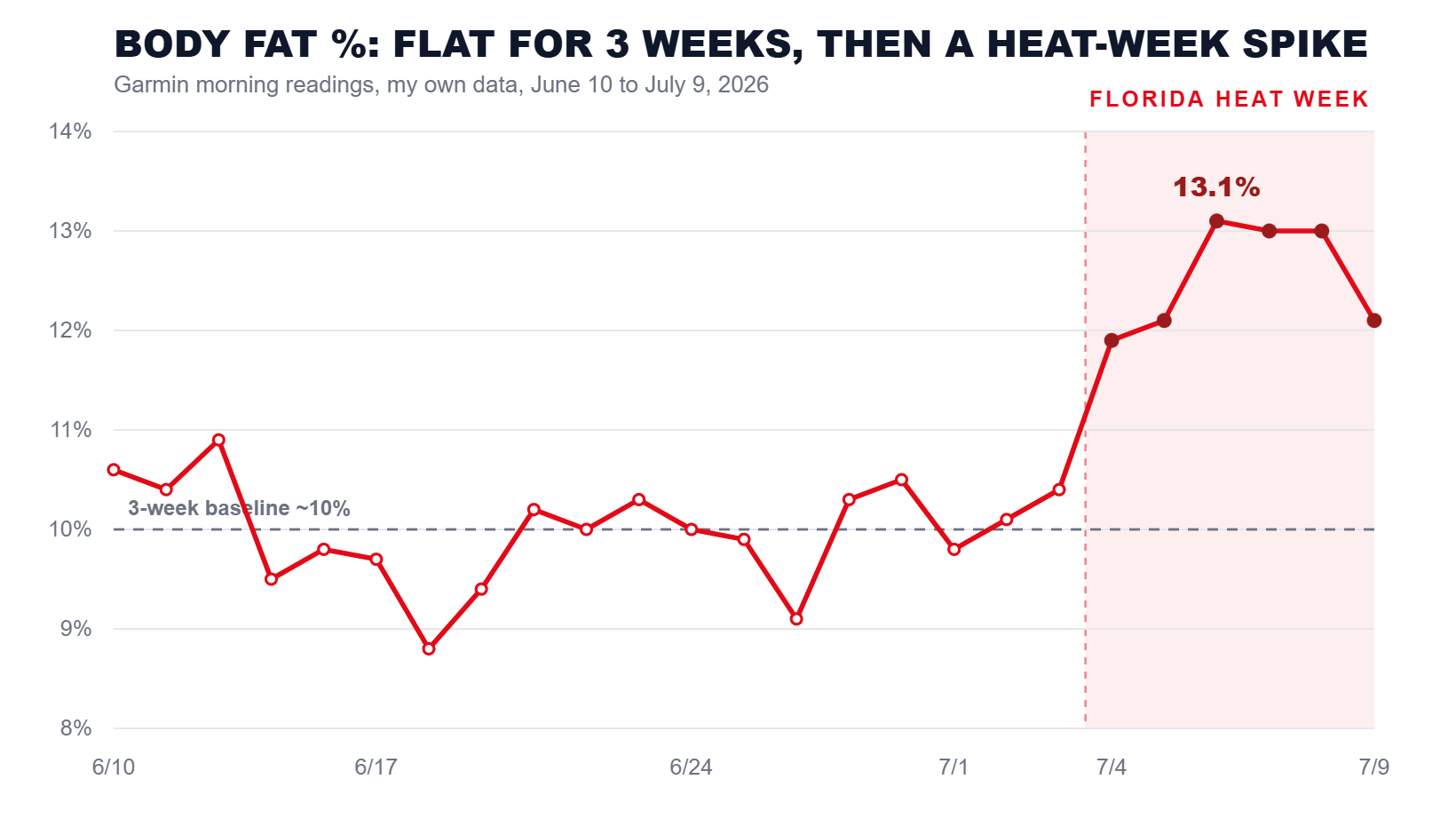
The scale went up. Then my Garmin told me my body fat had climbed from about 10 percent to 13 percent in five days.
If you have been at this any length of time, you know the feeling that follows. Frustration first, then the arithmetic. “I was perfect all week. How am I fatter?” And then the bad idea starts whispering: cut the calories, skip a meal, pull the carbs.
I did not touch a thing. Here is why, and why most riders in that exact moment do the wrong thing and quietly pay for it in fitness.
The math rules out fat
Start here, because it kills the panic in one move. A jump from 10 to 13 percent body fat on a 78 kilo frame is about 2.3 kilos, five pounds, of fat. Five pounds of fat is roughly 18,000 calories.
To actually gain that in five days I would have had to eat around 3,600 calories a day beyond everything I burned, while riding for hours in the heat. That is not a diet slip. It is not possible. So whatever the scale and the sensor were measuring, it was not fat.
What the scale is actually measuring
Body weight is not body fat. The scale weighs everything: bone, muscle, gut contents, the water in your blood, the fuel in your legs. On any given morning the fat you carry barely moves. What moves, sometimes by several pounds overnight, is water. And summer is a water storm.
Here is what was actually happening to me, and what happens to you every hot, high-volume week.
Your blood volume expands. This is the big one, and almost nobody talks about it. Train hard in the heat and your body adds plasma, the watery part of your blood. It is a survival adaptation: more fluid to sweat with, a bigger radiator to dump heat. The research is remarkably consistent here: heat acclimation expands plasma volume by roughly 4 to 15 percent in the first week of training in the heat. Plasma is mostly water, and water has weight. You did not get fatter. You upgraded your cooling system.
Your glycogen tanks are topped off. Train more and your muscles store more glycogen, the carbohydrate your legs run on. Every gram of glycogen is held alongside roughly three grams of water. String together a few solid days of training and fueling and you can be carrying a few pounds of water right there in the muscle, ready to be spent. That is not a problem. That is a loaded gun.
Heat, sodium, and travel push fluid around. You sweat more, drink more, salt your food more, eat differently on the road, and sit on a plane for hours. All of it changes how much fluid your body holds for a few days. None of it is fat.
And the body-fat sensor gets fooled. This is the one that spiked my chart. A smart scale or watch does not measure fat. It runs a tiny current through you, reads the resistance, and estimates fat from that. What it is really measuring is your body water. Train all day in the heat and you finish dried out, and a drier body reads as higher resistance, which the sensor reports as more fat. It was not reading my fat. It was reading my hydration, and my hydration was all over the place.
Add those up and a sharp jump during a disciplined, high-volume, hot week is not a warning. It is a receipt.
The check anyone can run
You do not have to take my word for it. Most smart scales give you a lean mass number too. Back the fat out of your weight and watch the lean figure. A real fat gain needs lean mass to hold while fat climbs. Mine did the opposite of a fat-gain story: lean mass sat flat at about 68 kilos all month while the body-fat percentage bounced around underneath it. Flat lean mass plus a jumping fat number equals water moving, not fat arriving. Run that check before you ever change your eating.
The lie, and why it is expensive
The lie is that the number is a verdict on your discipline. It is not. It is a snapshot of your fluid balance, taken on the one week your fluid balance is doing the most work.
Here is why believing it hurts you. The rider who panics cuts calories right when training volume is at its highest. Now you are underfueling a big block. You bonk workouts, recover badly, lose muscle, and blunt the very adaptation you were paying for in sweat. You trade real fitness for a lower number on a scale that was lying to you.
And it doesn’t stop at the scale
Here is the part I did not expect to be writing. The same week the scale lied to me, so did my power meter, in the other direction.
This week in Florida, in 91 degree heat that felt like 107, I started a hard interval session, got through the first block, and came apart. I aborted the workout and rode home in zone 2. Six bottles of fluid in two hours and I still could not hold the numbers. The next day I called it a bust and rode at 5am just to beat the sun. My DOM-Ai report put it without emotion: a normalized power of 227 watts on a session built for far more, intensity limping in at 0.57.
So there it was, the full summer double insult. The scale said I got fatter. The power meter said I got slower. Same week, same body, doing everything right.
It is the same lie wearing a second mask. In serious heat your body has to defend its core temperature, so it routes blood to your skin to shed heat instead of to your muscles to make power. Heart rate climbs, watts sag, and everything feels harder than the number says it should. That is not lost fitness. It is a body spending its budget on cooling instead of cranking, right now, in the moment.
I have lived the extreme version. At the 2018 six-hour World Time Trial Championships in Borrego Springs, I showed up having trained through an Indiana winter and rolled to the start line into high-90s desert heat. I was throwing up inside thirty minutes. My heart rate sat near 180 for the last two laps while my power fell through the floor, and then both legs cramped at once, quads, hamstrings, and calves, until I had to stop. The riders who beat me that day were not fitter than me. They had spent the week before acclimating in Borrego. That was the whole difference.
The part that should make you smile
Now the good news, and it is real. Everything that felt like falling apart this week, the water on the scale and the watts that went missing, is the visible cost of an adaptation your body is busy building. Push through the heat in a smart, repeated way and your body expands its blood plasma, and that expanded plasma is one of the most reliable performance adaptations in endurance sport. More plasma means a higher stroke volume: your heart moves more blood per beat, which shows up as a lower heart rate at the same power and better cooling under load. The tax is paid up front, in a week that feels awful. The dividend comes later.
Two honest caveats. One hot week is a down payment, not the finished adaptation; the real gains come from repeated, deliberate heat over two to three weeks. And the benefit fades within a week or two once you leave the heat, so it is use it or lose it. Which is exactly why you should use it. When you reach cooler air, or when the weather turns in the fall, put that fresh plasma toward something that counts in the first seven to ten days: a benchmark effort, a hard group ride, an FTP test.
So the “gain” is a positive dressed up as a negative, and so is the bad workout. The scale and the power meter both panic in the heat. Your job is to keep your head while they lose theirs. Borrego taught me the cost of not knowing that. Florida, this year, is me finally treating the heat as training instead of a threat.
What to actually watch
Weigh yourself if you like the data, but stop reading a single morning as a verdict. If you want signal instead of noise:
- Weigh fasted, first thing, after you pee, under the same conditions every day. Anything else is comparing noise to noise.
- Watch the trend over two to three weeks, not the daily number. Fat does not arrive overnight, and it does not leave overnight either.
- During a heat block, treat body-fat percentage as the least reliable number the scale gives you. Mostly ignore it.
- Judge a hot-weather workout by your effort and heart rate, not by the power number. The watts come back when the temperature drops.
- Watch how your clothes fit, your power at a given effort, and your heart rate at that effort. Those three tell you more than any sensor.
Fuel the work. Trust the trend. Let the water do its job.
The scale lies in the summer. Your legs, in the fall, tell the truth.
If you would rather have a coach reading the whole picture with you than face one number on a bad morning, that is exactly what we do at Rollfast. When you are ready, we are here.
Sources
A few of you asked where this comes from. Here’s the research behind each claim.
You can’t build 5 lb of fat in 5 days
This one’s arithmetic, not a study. Fat tissue runs roughly 7,700 calories per kilogram, so 2.3 kg requires about 18,000 calories above what you burned. The energy-balance principle behind it is as settled as sports science gets.
Heat training expands your blood plasma
- Périard JD, Travers GJS, Racinais S, Sawka MN (2016). Cardiovascular adaptations supporting human exercise-heat acclimation. Autonomic Neuroscience 196:52–62. Plasma volume expansion occurs within the first week; recognized range of 3–27% within the first days of exposure. Link
- Périard JD, Racinais S, Sawka MN (2015). Adaptations and mechanisms of human heat acclimation. Scand J Med Sci Sports 25(S1):20–38. The standard reference on the time course of heat adaptation. Link
- Heat Acclimatization overview, ScienceDirect Topics. Heat acclimatization results in 10–25% expansion of plasma volume, with close correlations between increased plasma volume and thermoregulatory and cardiovascular adaptation to heat. Link
- Hematological Adaptations to Prolonged Heat Acclimation in Endurance-Trained Males (2019). Front Physiol 10:1379. Cyclists averaging 38 years old — i.e. us. Plasma volume rose about 300 ml with heat training. Link
- A crossover control study of three methods of heat acclimation (2022). About two-thirds of the plasma volume expansion arrives in the first 24 hours. Link
Every gram of glycogen holds ~3 g of water
- Olsson K-E, Saltin B (1970). Variation in Total Body Water with Muscle Glycogen Changes in Man. Acta Physiol Scand 80:11–18. The original. Subjects storing 500 g or more of glycogen bound 3–4 g of water per gram — body weight rose 2.4 kg in four days on a carb-rich diet. Link
- Fernández-Elías VE et al. (2015). Relationship between muscle water and glycogen recovery after prolonged exercise in the heat in humans. Eur J Appl Physiol 115:1919–1926. Muscle biopsies after 150 minutes of cycling in hot-dry conditions — our exact scenario. Confirmed at least 3 g of water per gram of glycogen. Link
- Muscle Glycogen Assessment and Relationship with Body Hydration Status: A Narrative Review (2023). Nutrients. Plain-language summary of the whole glycogen/water relationship. Link
Your scale’s body fat number depends on your hydration
- Guida B et al. (1998). Relevance of hydration state of the fat free mass in estimating fat mass by body impedance analysis. The mechanism in one sentence: these devices estimate total body water, then convert it to fat-free mass assuming a fixed 73% hydration. When hydration shifts, that fixed value no longer matches reality — producing wrong estimates of fat-free mass, and in turn of fat mass. Link
- Science for Sport, Bioelectrical Impedance Analysis (BIA). Notes that the 73% assumption traces back to the chemical analysis of six cadavers (the Brussels Cadaver Analysis Study), and that hydration and glycogen levels both move the number. Link
- Kutáč P et al. (2020). Evaluating of altered hydration status on effectiveness of body composition analysis using bioelectric impedance analysis. Libyan J Med. Drinking water alone moved the fat-mass reading by 2.1% after 500 ml, up to 7.9% after 2 litres in men — with zero fat gained. Link
- Real-world assessment of Multi-Frequency BIA for measuring body composition in healthy physically active populations (2025). Eur J Clin Nutr. 1,000 adults against DXA. These devices are reliable but only moderately accurate — and only under controlled hydration, fed state, recent exercise, and time of day. A heat block violates every one of those. Link
Ride the heat adaptation while you have it
- Lorenzo S, Halliwill JR, Sawka MN, Minson CT (2010). Heat acclimation improves exercise performance. J Appl Physiol 109:1140–1147. The landmark study. Ten days of heat acclimation in trained cyclists improved time trial performance 6% in cool conditions (13°C) and 8% in the heat, alongside plasma volume expansion, higher maximal cardiac output, and a raised lactate threshold. Matched controls training in cool conditions showed no change. Link
- McCleave EL et al. (2017) and Rendell RA et al. (2017). Later randomised trials also reporting benefits that transfer to cooler conditions.
Worth knowing: this one’s an active debate. Other studies (Karlsen 2015, Keiser 2015, Scoon 2007) found no cool-weather transfer. There’s no evidence heat acclimation hurts cool performance — but the fair version is that the benefit shows up in some studies and not others. Overview of both sides
It fades in about two weeks
- Daanen HAM, Racinais S, Périard JD (2018). Heat Acclimation Decay and Re-Induction: A Systematic Review and Meta-Analysis. Sports Med 48:409–430. Loss of adaptation happens largely in the first two weeks away from the heat. Heart-rate adaptations persist about a week, are roughly 31% decayed by two weeks and 54% by three. Link
- Neal RA et al. (2016). Effect of Permissive Dehydration on Induction and Decay of Heat Acclimation. Front Physiol. Plasma volume expansion is among the fastest adaptations to acquire (~4–5 days) and the fastest to decay. Link

Related Posts
Unlocking Your Fat Loss Potential: Dr. Bill Campbell’s Insights & The Rollfast Approach
By Christine Tanner, Rollfast Coaching Longevity & Nutrition Expert Hey Rollfast community! Christine Tanner here. I recently had the chance to dive into a fantastic podcast featuring Dr. Bill Campbell, a world-renowned expert in fat loss and protein science. The insights he shared resonated deeply with our Rollfast Coaching philosophy, especially concerning Longevity, metabolic health, and building sustainable Strength and Speed. Dr. Campbell dismantles many common misconceptions
Ride Fast, Live Long: Ditching the Carbs with Ultra-Endurance Pioneer Sean Sako
In the world of endurance sports, a simple truth seems to dominate: carbohydrates are king. The industry tells us to constantly refuel to avoid the dreaded "bonk." But what if there's another way? A path that not only fuels incredible athletic feats but also prioritizes long-term health and longevity, allowing you to Ride Faster, Be Stronger, and Live Longer? In a recent Rollfast Coaching call, we