The Hot Zone Game: How Rollfast Turns a Mixed Group Ride Into a Workout for Every Rider
Speed · Group Rides
When a mixed group rolls out at one pace, somebody usually loses. The strong riders sit up and get bored, or the C riders get dropped and ride the last miles alone, and the coffee stop feels like an apology.
A recent thread on r/cycling asked the usual question: on a friends’ ride, should the group go at the pace of the slowest rider? The original poster was tired of two friends surging every hill and then waiting at the top with a long face. Waiting keeps people on the same road. It does not give the C riders a chance to race, or the A riders any work to do.
We run it as a game.
Assign Roles, Then Start the Game
On Rollfast group rides we set up games, or missions, and we assign a role to each rider. Then the game begins.
Here is how it works with a typical group of 9: 3 A riders, 4 B riders, and 2 C riders. We pick a “hot zone” with a defined start and a defined finish. We make the teams and we explain the rules before anyone rolls.
Team 1 rolls first
The 2 C riders, 2 of the B riders, and 1 A rider get the head start. The A rider cannot drop anybody. The B riders on Team 1 cannot drop anybody until 0.5 miles to go, or until a landmark you named at the start.
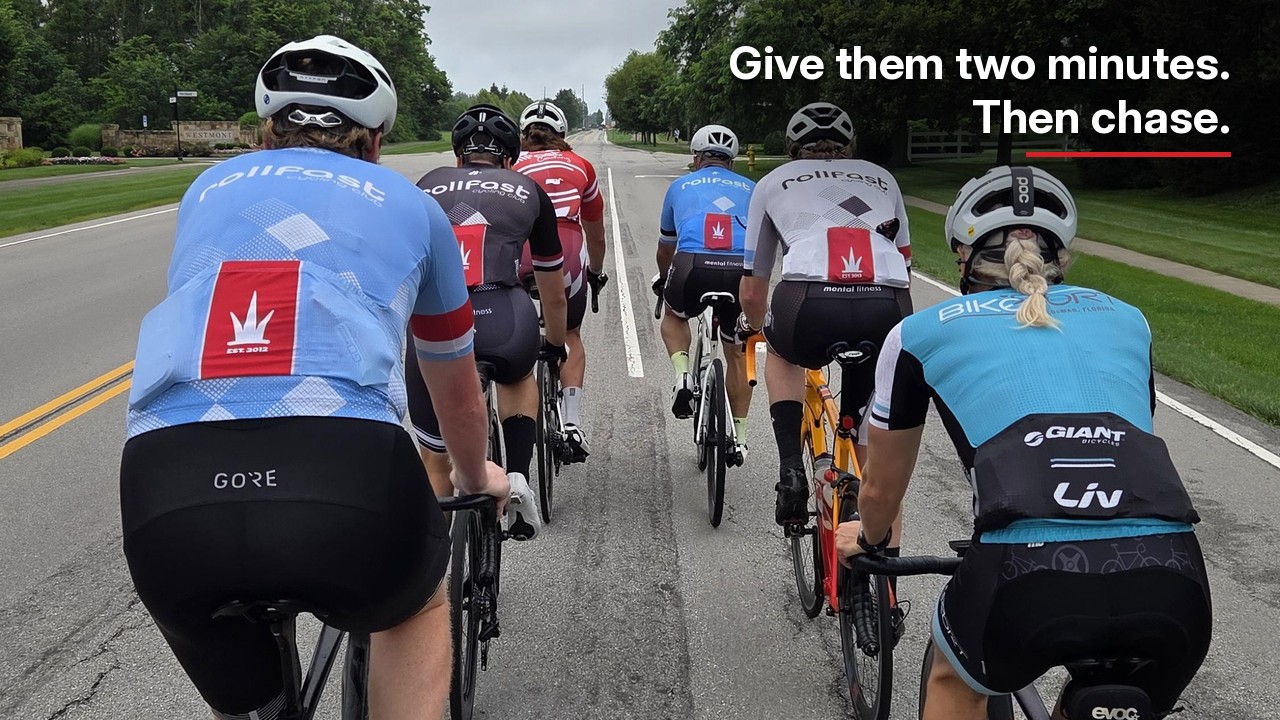
The chase group waits two minutes
The next group is the 2 remaining B riders and one A rider. They give Team 1 a 2-minute head start. Same rule: the A rider cannot drop the B riders.
The last A rider goes solo
One more minute later, they start chasing everybody. This rider is doing a maximum effort the entire time.
At 0.5 miles to go, or at that landmark, it is free reign. Anybody can attack and try to finish first. That is the whole game. The work is in the roles.
What Each Rider Is Actually Doing
The A rider on a team has a purpose: help teammates. They set a pace the group can hold, close gaps, take the wind, and keep the C riders in it. They do not get to ride off the front for fun. Their workout is riding for other people, plus the work of holding the group together when it starts to splinter.
The C riders get a real chance to stay away. They are racing to hold the lead, not hoping the group sits up. That is a different kind of excitement than a no-drop tempo ride, where the pace usually settles to the slowest rider.
The B riders are in the middle of the action either way. On Team 1 they have to stay together until the landmark. In the second group they are chasing, doing everything they can to catch and finish first.
The last A rider is doing a maximum effort the entire time. No team to sit in with, no one to pace. Just a clock and a bunch of jerseys up the road.
Everybody gets a workout. Everybody feels an accomplishment when the groups come back together. Everybody high-fives at the end.
That is the point. The game builds mental fitness, physical fitness, and club culture in the same stretch of road.
We Use the Same Style at Tucson Camp
This handicap race is the same style we use at our Tucson camp to equalize the climbing and help everybody finish near the same time. A straight group start on those long climbs would split the ride early. A staggered start, with faster riders chasing, turns the mountain into a team problem instead of a split that never comes back together.
On the Rollfast Standard, a group ride without a purpose in your plan is just riding, not training. The hot zone is the purpose.
How to Run It on Your Ride
You do not need 9 riders, and you do not need our roads. The example above is the version we use. What follows is guidance for scaling it and running it safely, not a new set of rules from that ride. Keep the same shape: a protected lead group, a chase group, and one strong rider starting last.
- 6 riders: 1 C, 1 B and 1 A in the first group, 1 B and 1 A in the second, 1 A solo. Start with the same 2-minute and 1-minute gaps, then widen or tighten them if the catch happens too early or never happens.
- 12 or more: keep the three-wave shape and add riders to the first two teams. Put at least one A rider in each team that has C or B riders, so someone is responsible for not dropping the group.
- On a climb: use the same handicap idea we use in Tucson. Set the gaps so you expect the groups to come together near the top, not in the first minute.
- Hot zone length: pick a stretch long enough that 2 minutes actually matters, often a few miles, with a start and finish everyone can see.
A few safety notes, because a game on a public road is still a ride on a public road:
- Put the hot zone on a low-traffic road with a clear sight line and a start and finish you can describe in one sentence (a sign, a driveway, a town-limit marker).
- The game pauses for cars, stop signs, and red lights. Traffic law wins every time. If the group has to stop, hold the gaps until you roll again, or restart from the next safe point.
- Regroup at the finish. High-fives happen when everyone is accounted for, not when the first rider sits up and rolls away.
- Explain the no-drop rules out loud, including the 0.5-mile or landmark free-reign point, before the first group leaves. If someone is new to group riding, put them in Team 1 with a patient A rider.
The first time you run it, the gaps will be a little wrong. That is fine. Talk about it at the finish, adjust the times, and run it again next week.
Sources
r/cycling. On a friends ride the group should go at the pace of the slowest rider
CyclingClub.cc. What Is a No-Drop Ride?
Rollfast Coaching. The Rollfast Standard
Rollfast Coaching. Training Camps (Tucson, February 21-26, 2027; staggered starts and teamwork)
Speed · Strength · Longevity
Make the Saturday ride count
If you want group rides like this built into your week, not left to chance on Saturday, that is what 1:1 coaching is for. The same handicap style is also how we ride the climbs at our Tucson camp, February 21-26, 2027.
See 1:1 coaching plans
Related Posts
Heart Fluttering on the Bike After 50? What a New Study of Veteran Cyclists Found About AFib
Your heart rate does something that makes no sense for the effort, or your chest flutters on the drive home. Here is what a new study of veteran cyclists found, what ablation delivers and what it can cost, and why training stress, life stress and what is on your plate may matter more than you think.
How to Ride Closer to the Wheel Without Panicking
Leaving a three-foot gap feels safe, but it means you're doing far more work than everyone else in the group, and you'll be the one cooked when the surge comes. The draft is free speed, and closing that gap is a skill you can build on purpose in three rides.
Everybody can hit 1000 watts!
Most men never hold 1,000 watts for a real sprint — and after 40, far fewer do. TrainerRoad's data kills the myth. Here's what Masters riders should train instead of chasing a vanity number.