

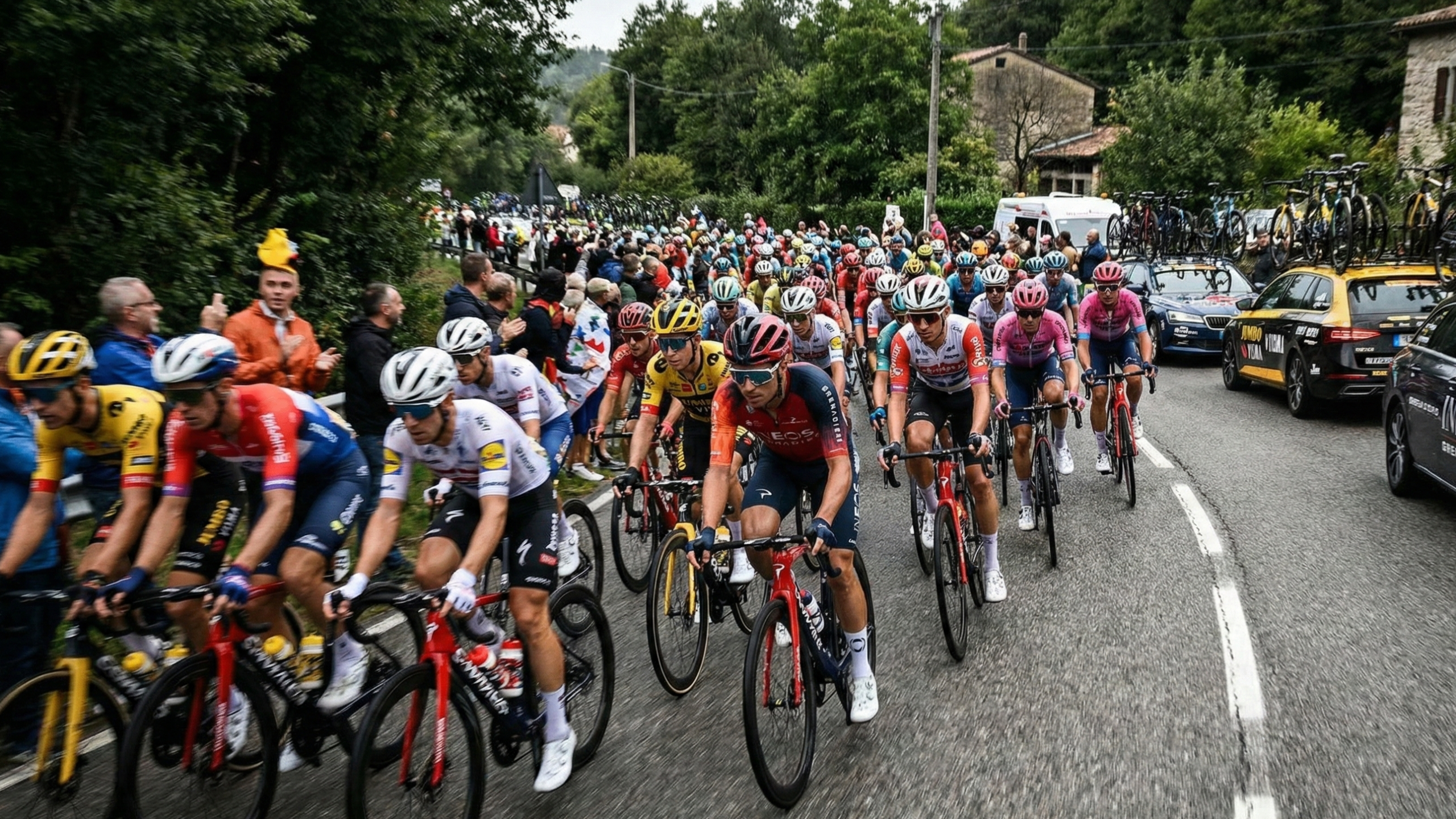
The WorldTour Lie
Why Training Like a Pro is Breaking You
We have all seen it happen on the Saturday group ride.
A strong rider—maybe 48 years old, successful career, kids at home—completely cracks. He bonks, not because he didn’t train enough, but because he’s running a specialized “fasted” protocol he saw on Instagram from a 22-year-old Tour de France contender.
He is applying a professional solution to an amateur reality, and it is destroying his physiology.
This is what I call the WorldTour Trap.
The “Expiration Date” Problem
We look at the pros and think, “If it works for Vingegaard, it works for me.”
But you are ignoring the reality of their job description.
A professional cyclist is a purpose-built machine designed for a career that effectively ends in their mid-30s. Their job is to mortgage their long-term health to cash in on short-term speed.
- Bone density loss? Accepted risk.
- Hormonal suppression? Part of the job.
- Chronic inflammation? The cost of doing business.
They are paid millions of dollars to make that trade. You are doing it for free.
As a Rollfast athlete, your goal isn’t to burn out by 35. It’s to be dropping your friends on climbs when you are 65. You are playing a different game, so why are you using their playbook?
The F1 Engine Mentality
Think of a pro cyclist’s body like a Formula 1 engine. It is a miracle of engineering, tuned for absolute maximum output.
But there is the catch.
An F1 engine is only designed to last for about 5 race weekends.
After that, it is scrapped. It has vibrated itself to death, the tolerances are shot, and it is tossed in the bin for a fresh one.
You do not have that luxury.
You cannot swap your engine when it blows up. You are driving the only chassis you will ever own, and it needs to last you 80 years, not 5 weekends.
If you run your body at the redline with “Pro” strategies—constant calorie deficits, extreme volume, and massive intensity—you are applying an F1 strategy to a vehicle that needs million-mile reliability. You will blow a gasket long before the finish line.
Here is the rule.
You can borrow performance from your health for a short time, but you cannot build health just by chasing performance.
If you train on a foundation of poor health—low testosterone, high cortisol, unchecked inflammation—the bill eventually comes due. You might get a season of good numbers, followed by two years of mysterious fatigue, injury, or burnout.
Building a Million-Mile Engine
Instead of asking, “What is Pogačar doing?” you need to ask, “What does my specific engine need to last?”
Real performance—the kind that lasts decades—is built on a foundation of biological data, not imitation.
This is why we built the Longevity Audit. We don’t guess based on trends. We look under the hood to see what your body can actually handle.
- Are you metabolically flexible enough for fasted rides? (Most aren’t).
- Is your inflammation low enough to handle a block of VO2 max intervals?
- Is your hormonal profile anabolic enough to recover from the stress you’re adding?
Most riders I know could be faster and stronger at 60 than they were at 40 if they stopped trying to be a “pro” and started treating their body like the high-performance investment it is.
Don’t let a generic protocol ruin your specific potential.

Related Posts


The Creatine Gap… Why Athletes Might Underdose Their Brains
Creatine used to be simple. Five grams per day